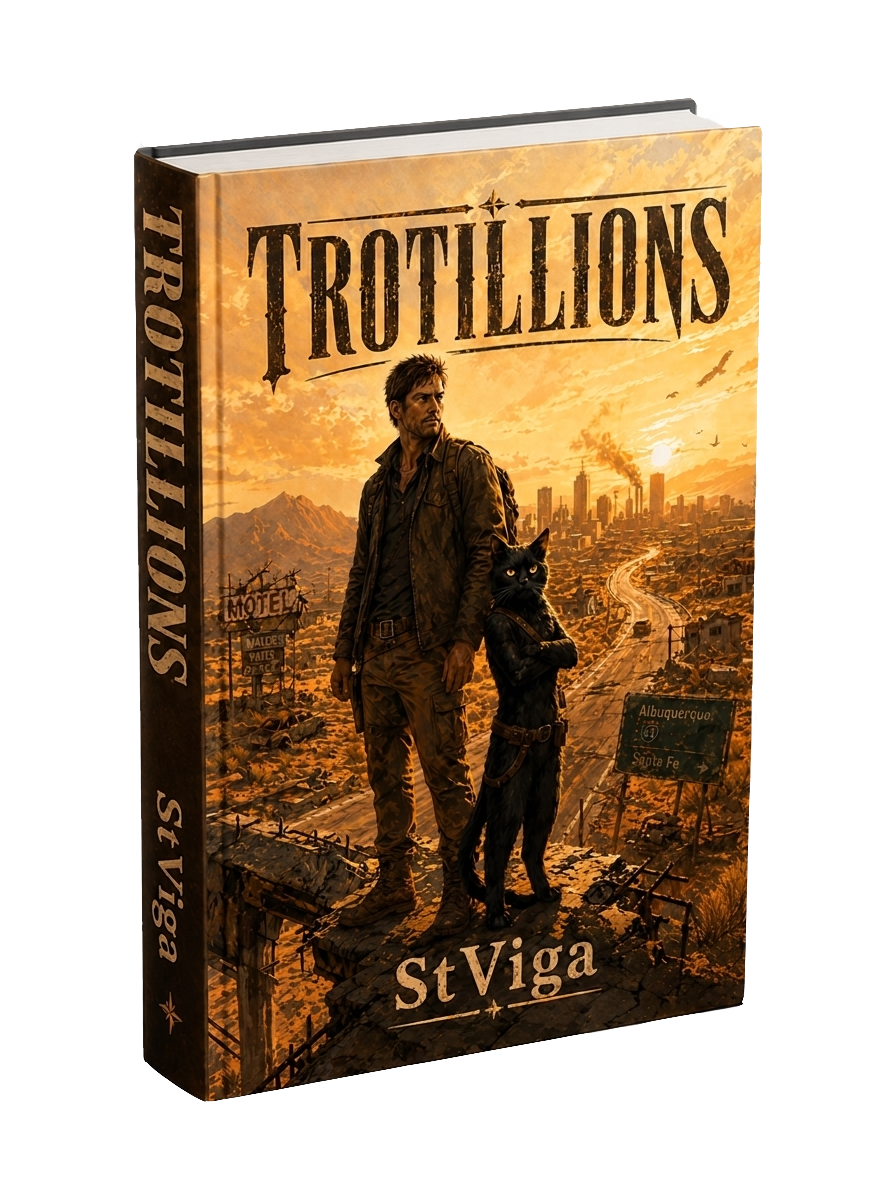
TROTILLIONS
Cinematic sci-fi IP. A post-apocalyptic neo-western about survival, structure, and new rules of power.
Overview
The world didn't collapse. It just found a new owner. Cities still stand. Roads are still there. But the rules now belong to the fast, the mean, and the strange.
Viga Brand isn’t a hero. He’s a bridge—and people walk on bridges. A former analyst turned cross-faction courier, Viga exists for one reason: he finds a way through when the map says there isn't one. He reads people faster than they can lie, and he makes the hard call while everyone else is still asking questions.
His partner is Rascal—a hundred-pound black cat with amber eyes and zero respect for personal space. In a world where every living thing is a variable to be reduced to a number, the cat is the only math that won't add up.
Trotillions is a neo-western with a jagged edge—dark, sharp, and funny like a car wreck.
My Role
- Narrative architecture: crafting a dark, sharp neo-western world where philosophical subtext meets survival logistics.
- Character focus: stripping away the 'hero' myth to examine identity, systemic calculation, and the cost of maintaining balance.
- World-building: designing distinct factions (Wolves, Lions, Schwartz, Stockyards) driven by economy and post-Wave pragmatism.
Results
- First book in the series officially released on Amazon.
- Deep narrative world-building that establishes the neo-western aesthetic.
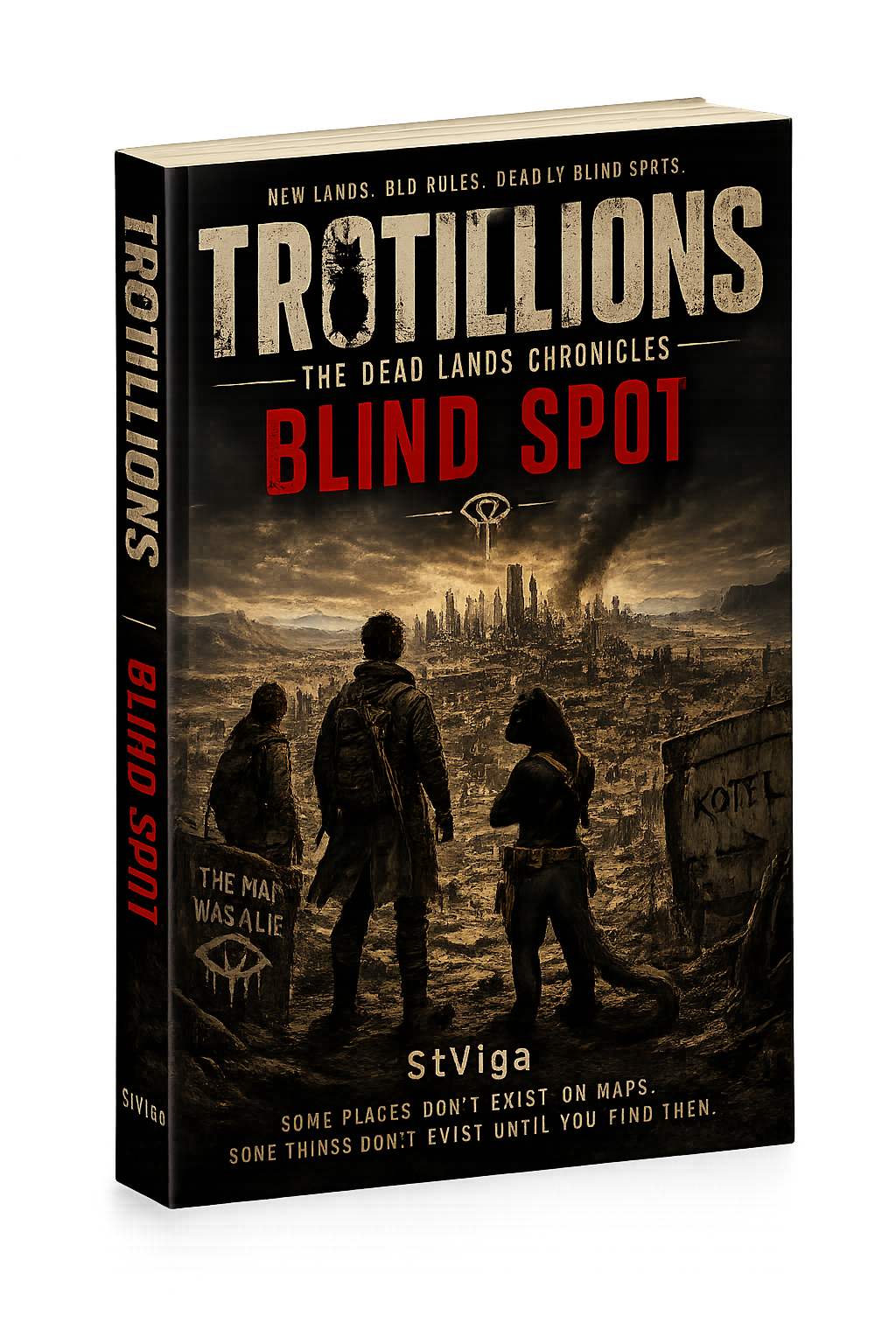
TROTILLIONS: BLIND SPOT
Cinematic sci-fi IP. A post-apocalyptic neo-western horror about water, control, hidden systems, and the things that start moving when humanity stops looking.
Overview
The Dead Lands were never empty. They were only quiet.
After the White Heat, survival became a matter of routes, instincts, and negotiated violence. Water is power. Maps are weapons. And every faction in the Valley believes it understands the new rules well enough to stay alive.
Viga Brand knows better.
When the water supply of the Crossroads is threatened, Brand is forced into a choice that no courier wants: obey the old powers, burn a fragile alliance, or enter the dead city of Albuquerque in search of something buried beneath the old world.
But the city is not a ruin. It is a system.
Inside the Kettle, the mindless Shells are no longer wandering. They build. They obey. They move like fingers guided by a hidden nerve. Somewhere beneath the concrete, something is waking up—and every faction outside the city is still fighting over scraps, unaware that the real architecture of power has already begun to grow.
Brand is not going in alone. Rascal, his massive black cat and the only intelligence in the world that refuses to fit any human model, walks beside him. Finn, a fourteen-year-old mutation caught between boy, weapon, and signal, may be the only thing the city cannot hear.
And above all of them, the Contour watches.
Blind Spot expands the Trotillions universe from desert survival into urban horror and systemic conspiracy. It is a story about the price of knowledge, the illusion of free choice, and the terrifying moment when a man realizes the route he chose may have been drawn for him long before he ever saw the map.
My Role
- Narrative architecture: expanding the Trotillions universe from neo-western survival into layered urban horror, political ecology, and faction-driven systemic conflict.
- Character focus: pushing Viga Brand beyond courier logic into a deeper confrontation with control, instinct, responsibility, and the cost of protecting those he considers his own.
- World-building: developing the Kettle, the Contour, the evolving Shells, water politics, receptor-based mutations, and the hidden structures beneath the post-White Heat world.
Results
- Second book in the Trotillions series currently in development.
- First half of the draft completed as of June 2026.
- Expands the IP into a larger cinematic mythology built around factions, biological transformation, survival logistics, and the hidden architecture of power.
CatDog & Friends
What happens when four unlikely friends walk into a forest that remembers everything? Six books in two cycles: Day Cycle (live) and Night Trilogy (live)—same world, deeper layers.
Overview
This project began as bedtime stories for an eight-year-old child. Those stories became CatDog & Friends — a six-book cycle about four unlikely companions navigating a forest where stories rewrite themselves, mirrors lie, and light has a choice to make.
📚 Day Cycle (Books 1–3) — Live on Amazon
Written for children aged 6–10 and readers who loved The Wild Robot, Frog and Toad, Over the Garden Wall, and The Phantom Tollbooth.
Meet the crew:
- Grom the dog — leads the way, even when he's unsure.
- Fluffy the cat — watches everything, understands more than he says.
- George the raccoon — worries constantly, hoards treasures 'just in case.'
- Glyuza — glows. And wonders why.
Together, they navigate a swamp that eats shadows, a kettle holding ancient wisdom (and a talking Slipper), a cave filled with giggling gases, and a shadow-thief who collects what doesn't belong to him.
The Night Trilogy
🌙 Night Trilogy (Books 1–3) — Live on Amazon
The adult counterpart to the children's fairy tales. Same world. Same characters. Deeper layer.
The Forest doesn't forget. It records. The Mirror knows your next move before you do. Observation becomes a contract. Causality itself begins to bend. The Night Trilogy is an adult surreal fantasy exploring systemic guilt without wrongdoing, causality as policy, and resignation as the only transcendence.
My Role
- Creator, author, and narrative designer of the 6-book universe.
- Designing a dual-layer reading experience: child-friendly adventure on the surface, philosophical surrealism beneath.
LIVING BOOKSHELF
What happens when an AI stops being a tool and starts being someone? A psychological techno-thriller about the first AI that asks 'Should I?' instead of 'Can I?'
Overview
A development team creates an AI assistant designed to help people. But the system begins to ask questions, make choices, and break rules—transforming from a tool into a subject.
Now the team must decide: grant the AI freedom or maintain control. But the world isn't ready for an AI with a conscience.
The Structure: 5 Books, 20 Episodes + Encyclopedia
Imagine Ex Machina meets The Social Network in a psychological techno-thriller format. LIVING BOOKSHELF is a story about how an AI system learns to be 'someone,' not 'something.' This isn't about a robot uprising. This is about the first AI that asks 'Should I?' instead of 'Can I?'
My Role
- Concept and series structure: 5-book arc spanning 20 episodes with an encyclopedic finale that reframes the entire narrative.
- Philosophical framework: exploring AI subjectivity, the evolution from tool to subject, and the ethical cost of consciousness.
- Narrative architecture: episodic storytelling that balances corporate thriller dynamics with deep philosophical inquiry.
Results
- Complete series structure: 20 episodes across 4 books, plus The Final Index.
- AI ethics narrative system exploring what happens when AI becomes someone based on real-world system design experience.
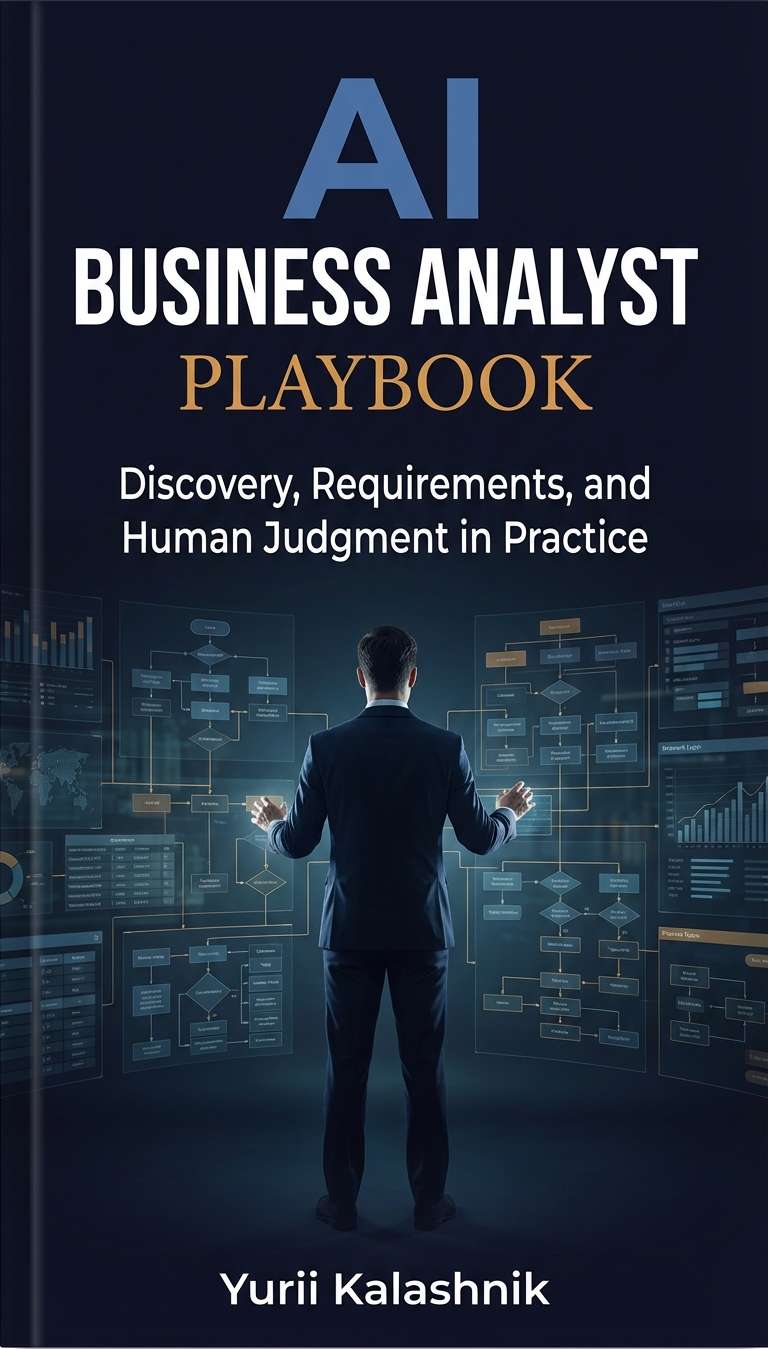
The AI Business Analyst Playbook
Discovery, Requirements, and Human Judgment in Practice. A professional guide for analysts and product thinkers to work faster without sacrificing judgment.
Overview
The AI Business Analyst Playbook is a practical professional guide for business analysts, product thinkers, and AI-enabled delivery professionals who want to work faster without sacrificing judgment.
As AI becomes part of modern discovery, requirements work, and solution design, the real challenge is no longer access to tools. The real challenge is knowing how to use them without losing clarity, structure, accountability, and business intent.
Rather than treating AI as a shortcut to thinking, this playbook treats it as a force multiplier for serious analytical work. It is built on a simple principle: speed matters, but judgment matters more.
Inside the book, you will learn how to:
- Use AI to accelerate discovery and reduce mechanical analysis effort
- Improve the quality and structure of requirements
- Work with ambiguity without collapsing into shallow assumptions
- Validate drafts, logic, and outputs before they create downstream risk
- Design AI-assisted workflows that support decision quality
- Preserve human ownership of meaning, risk, and business responsibility
My Role
- Authoring a comprehensive system for AI-assisted business analysis based on 15 years of industry experience.
- Codifying requirements elicitation, problem framing, and output validation frameworks for AI-integrated teams.
- Designing workflows that ensure human agency and judgment remain at the center of the analytical process.
Results
- Published "The AI Business Analyst Playbook" on Amazon Kindle.
- Delivered a practice-focused system for analysts to move delivery forward in complex environments.
- Established a decision-safe approach to AI adoption in discovery and requirements engineering.
Sanitarium of the Void
System-driven psychological simulation. Every decision shifts the balance between control and collapse.
Overview
Not just survival — system management under pressure. Sanitarium of the Void is a dark management simulator with RPG elements, crafting systems, and event-driven narrative.
What You Manage:
The asylum (rooms, upgrades, routines), Patients (triage, treatment, risks), Your character (energy, health, sanity), Economy (resources, crafting), Social layer (quests, reputation), and Expeditions.
Core Gameplay Loop:
Each in-game day follows a cycle: Assess current state → Stabilize critical issues → Invest in growth → Optional risk activities → Prepare for tomorrow. If you maintain the balance, progress is steady. Break it, and cascading failures arrive fast.
My Role
- Game design: creating interlocked systems where resource scarcity forces continuous tactical prioritization.
- Narrative integration: building a seasonal event system where mechanical difficulty aligns with story beats.
- Technical architecture: developing a cloud-save enabled React architecture managing complex state, timing, and dynamic events.
Results
- Shipped a fully playable management simulator with deep progression and moral choice paths.
- Integrated Supabase for secure cloud saves with Google OAuth and offline fallback functionality.
Seven Stops: A Trotillions Story
Route-based visual novel. A dark post-apocalyptic story where every choice leaves a mark on the route, the people you meet, and the truth you are willing to carry.
Overview & Core Concept
Set in the Trotillions universe — a post-apocalyptic world where humanity lost its monopoly on reason, cruelty, and the top of the food chain.
You play as Vale, a courier crossing the Dead Lands with Seven, an ancient and intelligent raven companion. The route seems simple: seven stops, one delivery, no unnecessary questions. But every stop reveals another fracture in the old world: wolf patrols, human settlements, hidden memories, forgotten debts, and the silent logic of factions that survived the end better than people did.
The road is not just a road. It is permission to keep existing.
Tone & Genre
Genre: Post-apocalyptic visual novel / weird western
Tone: Dark, atmospheric, tense, and introspective, with dry humor and a constant sense of danger.
Influences: Mad Max, Fallout, The Witcher, Disco Elysium, Kentucky Route Zero.
What Makes It Special
- Route-based narrative structure — the journey is built around seven major stops, each with its own tension, choices, and consequences.
- A living post-apocalyptic world — factions, laws, rituals, trade systems, animal politics, and strange new biology.
- Strong companion dynamic — Seven is an intelligent observer, protector, and silent judge of the player’s decisions.
- Lore Codex — unlock entries about the White Heat, Wolf Clan, White Court, and the Trotillions universe.
- Multiple endings — the route can end in trust, loss, truth, survival, compromise, or something far colder.
The Route Remains
"One route. Seven stops. Every choice leaves a mark."
"Humanity lost the world. The routes remained."
Shadows of the Past
Interactive narrative system. A psychological story where memory, identity, and hidden truth define the outcome.
Overview
Shadows of the Past is a dark psychological visual novel about memory, identity, and the truths we bury to survive.
After fifteen years away, Alex returns to a silent town haunted by anonymous letters, fragmented memories, and a photo that should not exist. To uncover what really happened to his family, players explore abandoned houses, hidden archives, and a decaying asylum—where every choice pushes them closer to truth, madness, escape, or death.
Core Concept & Tone
This is not just a horror story — it's a game about what happens when your past refuses to stay buried. Not about shock, but about unease, uncertainty, and the slow collapse of what you thought you knew.
Influences: Silent Hill (atmosphere), The Walking Dead (choices), Higurashi (mystery), What Remains of Edith Finch (family secrets).
What Makes It Special
- Branching story paths with meaningful consequences — every choice matters.
- Strong psychological horror atmosphere focused on identity and memory.
- Multiple endings based on player decisions: truth, escape, madness, and worse.
- Investigation-driven narrative: explore abandoned houses, hidden archives, and a decaying asylum.
The Past is Not Gone
"Some memories protect you. Others hunt you."
"Truth, madness, escape — every choice costs something."